CHALLENGE INFORMATION
Platform: TryHackMe
Path: Pre Security
Module: Network Fundamentals
Room: OSI Model
Description: Learn about the fundamental networking framework that determines the various stages in which data is handled across a network.
What Is the OSI Model?
This room introduces the OSI model and its seven layers. To remember the layers in order from Layer 1 to Layer 7, we use the following mnemonic: Please Do Not Throw Sausage Pizza Away.
D–Do - Data Link Layer - Layer 2
N–Not - Network Layer - Layer 3
T–Throw - Transport Layer - Layer 4
S–Sausage - Session Layer - Layer 5
P–Pizza - Presentation Layer - Layer 6
A–Away - Application Layer - Layer 7
Alternatively, one may use the mnemonic All People Seem To Need Data Processing to remember the layers in reverse order (Layer 7 to Layer 1). Use whichever method suits you better.
Question 1: What does the OSI in OSI Model stand for?
Open Systems Interconnection
Question 2: How many layers (in digits) does the OSI model have?
7
Question 3: What is the key term for when pieces of information get added to data?
encapsulation
Layer 7 - Application
The application layer is the topmost layer of the OSI model, where users interact with software applications. This layer provides the interface between end-user applications and network services.
Question 1: What is the name of this layer?
Application
Question 2: What is the technical term that is given to the name of the software that users interact with?
Graphical User Interface
Layer 6 - Presentation
The presentation layer acts as a translator between the application layer and the network. It is responsible for data formatting, encryption, and compression, ensuring that data sent from one system can be read by another.
Question 1: What is the name of this layer?
Presentation
Question 2: What is the main purpose that this layer acts as?
Translator
Layer 5 - Session
The session layer establishes, manages, and terminates connections between applications. It handles session establishment, maintenance, and synchronization, allowing for organized communication exchanges.
Question 1: What is the name of this layer?
Session
Question 2: What is the technical term for when a connection is successfully established?
Session
Question 3: What is the technical term for small chunks of data?
Packets
Layer 4 - Transport
The transport layer is responsible for end-to-end communication and data flow control.
This section covers the two primary protocols at this layer: Transmission Control Protocol (TCP) and User Datagram Protocol (UDP). TCP provides reliable, ordered delivery of data, while UDP offers faster, connectionless communication without guaranteed delivery.
Question 1: What is the name of this layer?
Transport
Question 2: What does TCP stand for?
Transmission Control Protocol
Question 3: What does UDP stand for?
User Datagram Protocol
Question 4: What protocol guarantees the accuracy of data?
TCP
Question 5: What protocol does not care if data is received by the other device?
UDP
Question 6: What protocol would an application such as an email client use?
TCP
Question 7: What protocol would an application that downloads files use?
TCP
Question 8: What protocol would an application that streams video use?
UDP
Layer 3 - Network
The network layer handles logical addressing and routing. It determines the best path for data to travel from source to destination across multiple networks. This layer uses Internet Protocol (IP) addresses to identify devices and routing protocols to select optimal paths.
Question 1: What is the name of this layer?
Network
Question 2: Will packets take the most optimal route across the network? (Y/N)
Y
Question 3: What does the acronym OSPF stand for?
Open Shortest Path First
Question 4: What does the acronym RIP stand for?
Routing Information Protocol
Question 5: What type of addresses are dealt with at this layer?
IP Addresses
Layer 2 - Data Link
The data link layer provides node-to-node data transfer and handles physical addressing through Media Access Control (MAC) addresses. It is responsible for framing, error detection, and flow control at the local network level. Every networked device requires a Network Interface Card (NIC) to operate at this layer.
Question 1: What is the name of this layer?
Data Link
Question 2: What is the name of the piece of hardware that all networked devices come with?
Network Interface Card
Layer 1 - Physical
The physical layer is the lowest layer of the OSI model, responsible for the physical connection between devices. It defines the electrical, mechanical, and procedural specifications for activating, maintaining, and deactivating physical links. This layer transmits raw bit streams (binary data) over physical media such as Ethernet cables, fiber optics, or wireless signals.
Question 1: What is the name of this layer?
Physical
Question 2: What is the name of the numbering system that uses only 0s and 1s?
Binary
Question 3: What is the name of the cables that are used to connect devices?
Ethernet Cables
Practical - OSI Game
In this practical exercise, we navigate a dungeon game that reinforces the order of the OSI model layers. The objective is to escape the dungeon by climbing through the levels in the correct order (Layer 1 through Layer 7) to retrieve the flag.
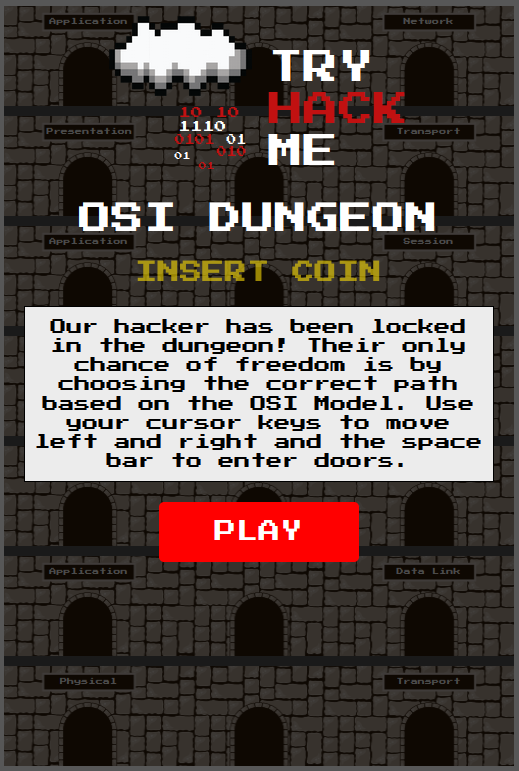
Figure 1: OSI game - start screen
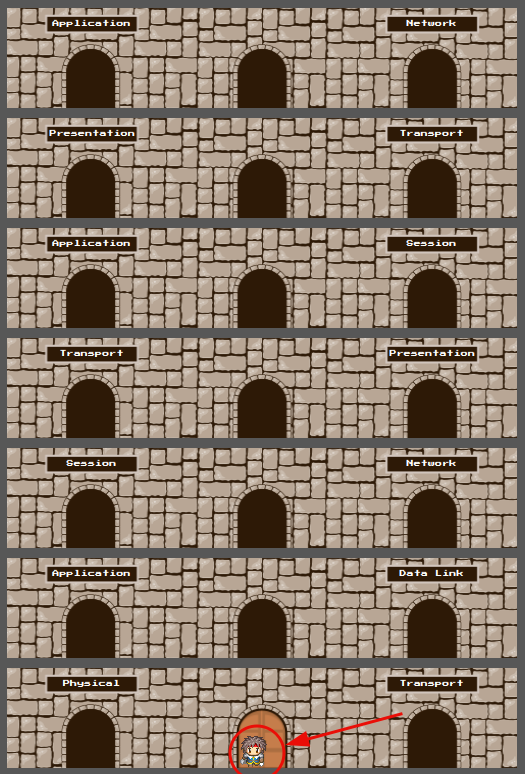
Figure 2: OSI game - Level 1 (Physical)
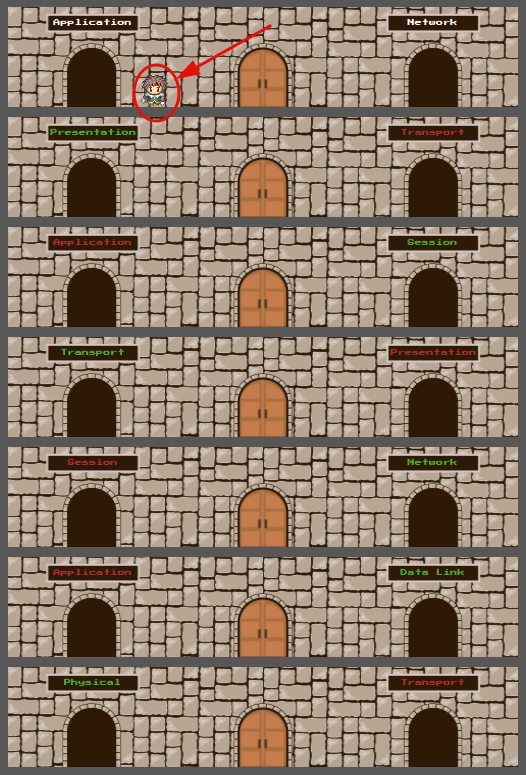
Figure 3: OSI game - Level 7 (Application)
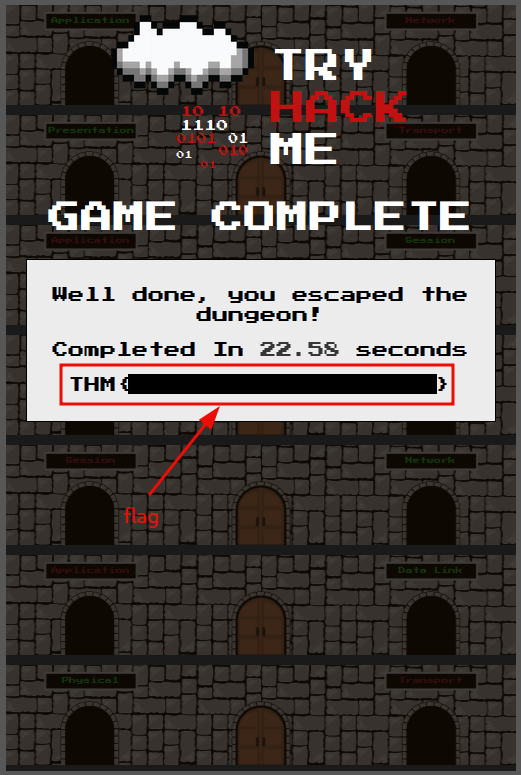
Figure 4: OSI game - redacted flag
Question 1: Escape the dungeon to retrieve the flag. What is the flag?
<redacted-flag>
Continue Your Learning: Packets and Frames
This concludes the OSI Model room. We recommend proceeding to the next room in the module to continue building your networking fundamentals.
Question 1: Join the Packets and Frames room.
No answer needed