CHALLENGE INFORMATION
 | Platform: TryHackMe Path: Red Teaming Module: Red Team Fundamentals Room: Red Team OPSEC |
DESCRIPTION:
Learn how to apply Operations Security (OPSEC) process for Red Teams.
Introduction
Operations Security (OPSEC) is a military and cybersecurity process designed to protect sensitive information by denying adversaries access to details about an organization’s capabilities and intentions.
The OPSEC process comprises five key steps:
- Identifying critical information
- Analyzing threats
- Analyzing vulnerabilities
- Assessing risks
- Applying appropriate countermeasures
From the red team’s viewpoint, OPSEC involves simulating attacks against a blue team’s defenses to test and enhance security measures. Despite being authorized, this activity challenges the blue team’s objectives, aiming to breach their systems while safeguarding the red team’s own information.
Frameworks like Lockheed Martin’s Cyber Kill Chain and MITRE ATT&CK are essential tools for identifying adversary tactics and enhancing OPSEC.
Ultimately, OPSEC is not a set of static rules but a dynamic process focused on protecting critical information and preventing adversary access.
Question 1: Aim to memorize the five steps of the OPSEC process as we explain each one in its own task.
No answer needed
Critical Information Identification
In red team operations, critical information refers to any data that, if disclosed to an adversary (such as the blue team), could undermine the mission’s success. This includes:
- Client Information: Sensitive details about clients, such as employee names or infrastructure, must be protected under a need-to-know basis to prevent operational compromise.
- Red Team Identities and Activities: Disclosing red team identities or plans can allow adversaries to better prepare against their attacks.
- Tactics, Techniques, and Procedures (TTPs): Revealing the specific methods used in attacks could aid adversaries in counteracting these tactics.
- Operating Systems and Tools: Exposing tools like Pentoo or C2 frameworks can tip off adversaries, enabling them to mitigate such attacks more effectively.
- Public IP Addresses and Domain Names: Disclosing these details allows blue teams to block or sinkhole malicious activities, potentially neutralizing red team operations.
The Principle of Least Privilege (PoLP) is crucial here, ensuring that only essential personnel have access to critical information, minimizing potential leaks and maintaining operational security.
Question 1: Click on View Site and follow through till you get the flag.
Please note that some browser extensions, such as NoScript, might prevent the site from loading correctly.
<redacted-flag>
Here are the answers to the questions related to OPSEC Critical Info. The hint provides the rationale for each decision.
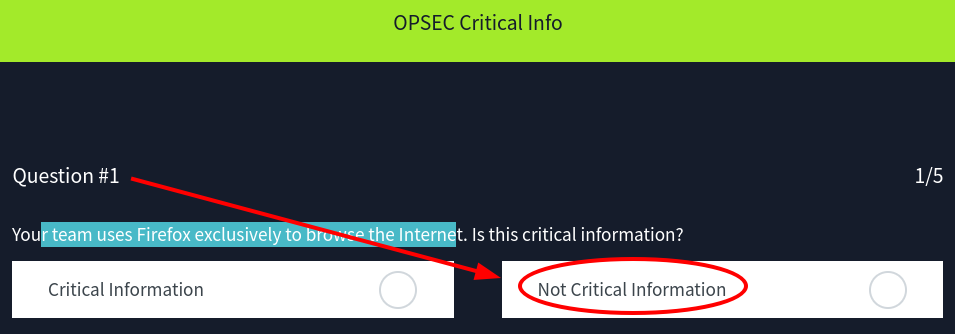


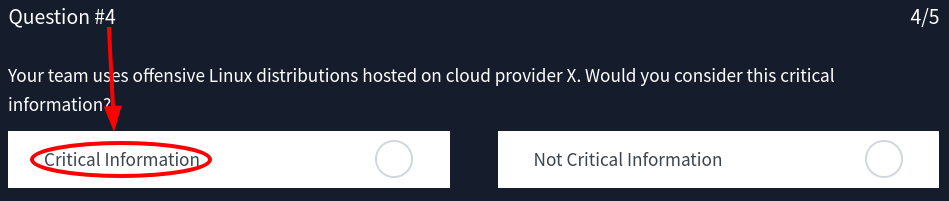
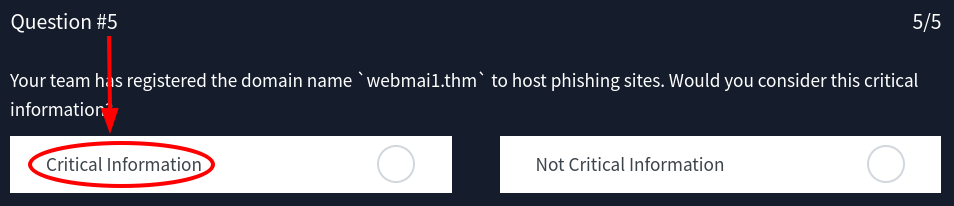
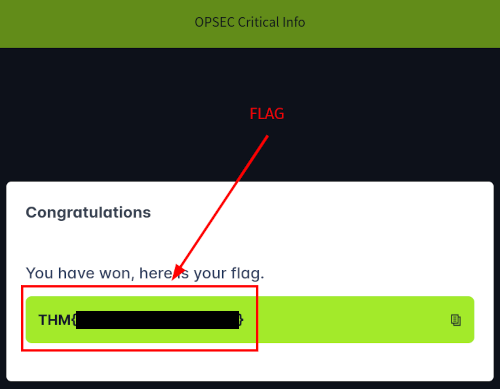
Lastly, make sure to grab the flag.
Threat Analysis
Threat analysis is a critical aspect of red team operations, focusing on identifying potential adversaries based on their intentions and capabilities. The goal is to answer key questions about who the adversary might be, their objectives, tactics, techniques, and procedures, as well as any critical information they may have obtained.
Adversary Identification
Determine who the potential threat could be, whether internal (blue team) or external parties.
Intent and Capabilities
Assess the adversary’s intent and their capacity to execute malicious actions against the red team’s objectives.
The red team’s mission is to emulate an attack scenario, helping the blue team identify security gaps. The blue team aims to protect their network from intruders, including both known adversaries and potentially malicious third parties with varying capabilities.
In summary, any adversary with the intent and capability to disrupt the red team’s objectives is considered a threat, defined as:
Question 1: Try to think of at least one adversary who is not a threat and one who is a threat.
No answer needed
Vulnerability Analysis
Question 1: Your red team uses THC-Hydra to find the password for a specific login page. Moreover, they are using the Metasploit framework on the same system as THC-Hydra. Would you consider this an OPSEC vulnerability? (Y/N)
Y
Question 2: One of the red team members posts a photo of his cat every day. Would this be considered an OPSEC vulnerability? (Y/N)
N
Question 3: Your red team went for dinner, took a photo, and tagged every team member on a popular social media platform. Would you consider this an OPSEC vulnerability? (Y/N)
Y
Hint Quote: “Such a photo exposes the identities of the red team members, and using OSINT, it would be possible to discover the skill set and the level of expertise of each member.”
Question 4: Your red team posts on its website a list of clients you regularly conduct red team exercises with. Would you consider this an OPSEC vulnerability? (Y/N)
Y
Question 5: One of your red team members posted a photo of her morning coffee. Would you consider this an OPSEC vulnerability? (Y/N)
N
Risk Assessment
A risk assessment is essential in OPSEC to evaluate the likelihood of an event occurring and its potential impact. This involves analyzing how adversaries might exploit identified vulnerabilities.
Factors to consider when assessing risk:
- Effectiveness: How well do countermeasures reduce the risk?
- Cost-Benefit Analysis: How does the cost of implementing countermeasures compare to the vulnerability’s impact?
- Disclosure Risk: Could a countermeasure reveal information to adversaries?
Example-1: Single IP Address Vulnerability
- If an adversary can detect one activity, they may block all related activities.
- With a SIEM in place (allowing real-time monitoring), risk is high.
- Without such tools or limited adversary capabilities, risk might be low.
Example-2: Unsecured Database
- High risk due to frequent targeting by malicious actors with minimal security measures.
By systematically evaluating these factors and examples, red teams can identify and mitigate risks effectively in OPSEC scenarios.
Question 1: Your red team uses THC-Hydra to find the password for a specific login page. Moreover, they are using the Metasploit framework on the same system as THC-Hydra. Knowing that your target uses a properly configured Intrusion Detection System (IDS), would you consider this vulnerability as high risk? (Y/N)
Y
Countermeasures
The final step in addressing vulnerabilities involves applying countermeasures as defined by the U.S. Department of Defense (DoD) Operations Security (OPSEC) Program Manual, which aim to protect critical information by preventing detection, providing alternative interpretations (deception), or denying adversaries’ collection efforts.
Example-1: Running Nmap and Metasploit with a single public IP for phishing pages is vulnerable because detection could block all activities. Using separate IPs mitigates this risk.
Example-2:: An unsecured database storing data from phishing pages poses high risk due to potential targeting by malicious actors. Securing the database ensures only authorized access, reducing this vulnerability.
Question 1: This concludes the fifth element in the OPSEC process. Let’s get ready before we apply all five elements to other instances of critical information.
No answer needed
More Practical Examples
In this task, we apply the five elements of the OPSEC process to red team activities involving programs, operating systems (OS), and virtual machines (VMs). The goal is to mitigate risks associated with these tools and configurations. Here is a structured summary:
Identify Critical Information
Focus on program names, OS versions, VM hostnames, and user agents that could be logged by blue teams.
Analyze Threats
Monitor for malicious activity through network logs, such as detecting tools like Nmap using their default user agents.
Assess Vulnerabilities
Unique configurations in OS or VM setups can make activities more traceable back to the red team.
Evaluate Risk
Risks are influenced by services used (e.g., VPNs logging extensive information), increasing visibility and potential detection.
Apply Countermeasures
- Camouflage OS signatures to avoid detection.
- Rename VMs and physical hosts to match client conventions, avoiding distinct names like AttackBox.
- Use custom user agents for tools (e.g., Nmap) with options like
--script-args http.useragent="CUSTOM_AGENT"to prevent identification.
The example provided illustrates how setting a custom user agent can help obscure tool usage, reducing detection chances. This approach ensures red team activities remain inconspicuous and effective.
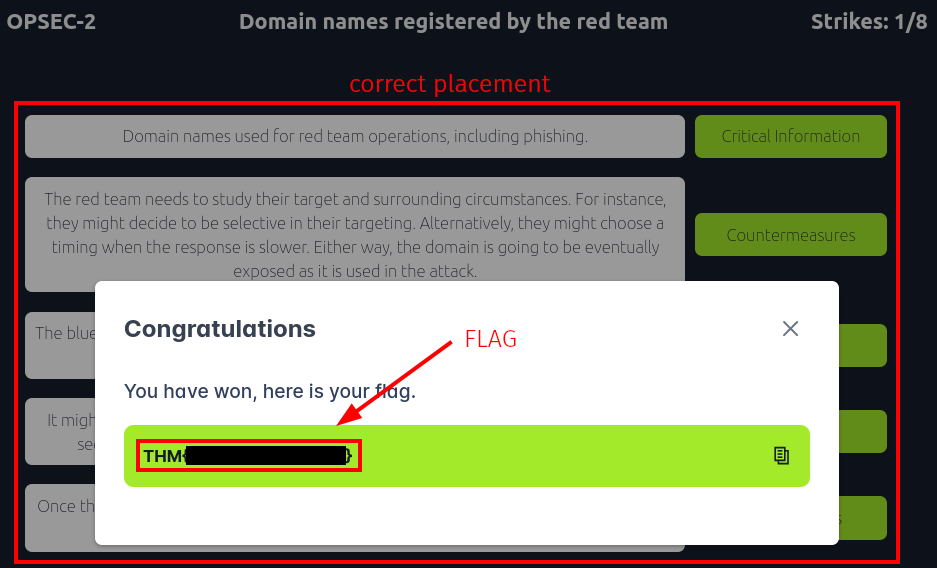
Question 1: Click on View Site and follow through till you get the flag. Please note that some browser extensions, such as NoScript, might prevent the site from loading correctly.
<redacted-flag>
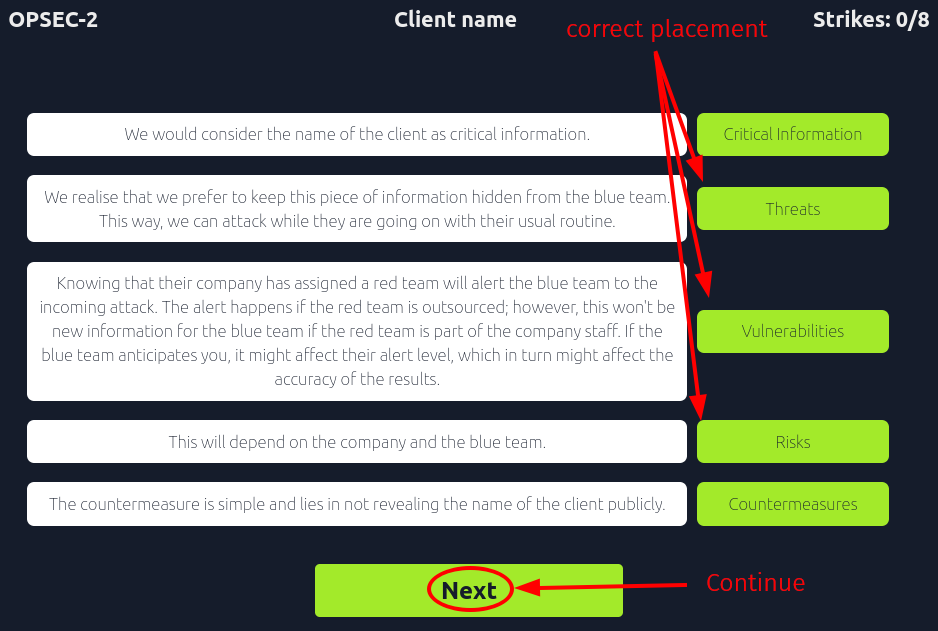
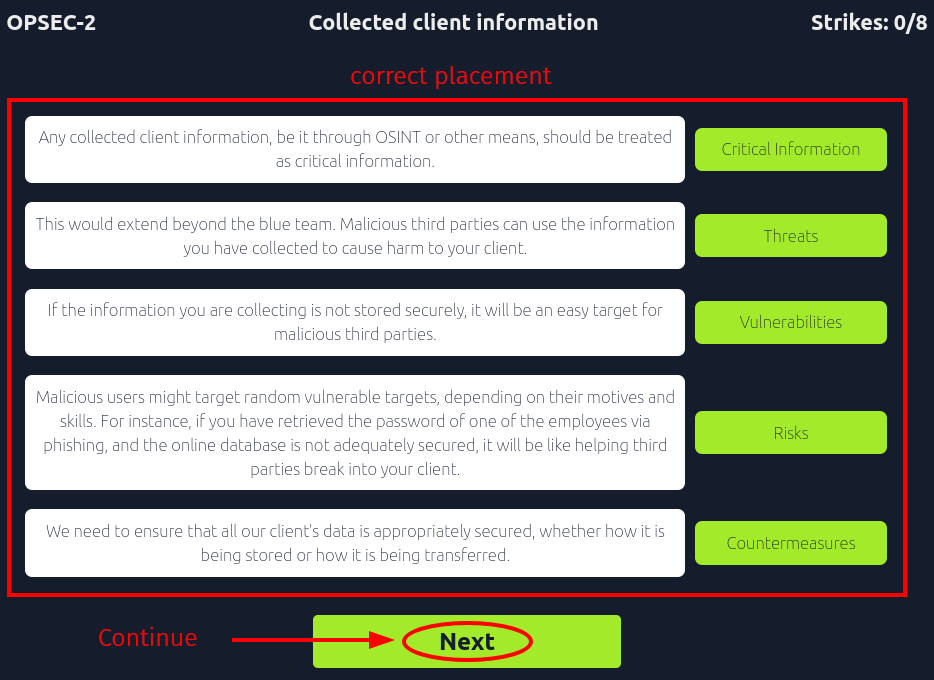
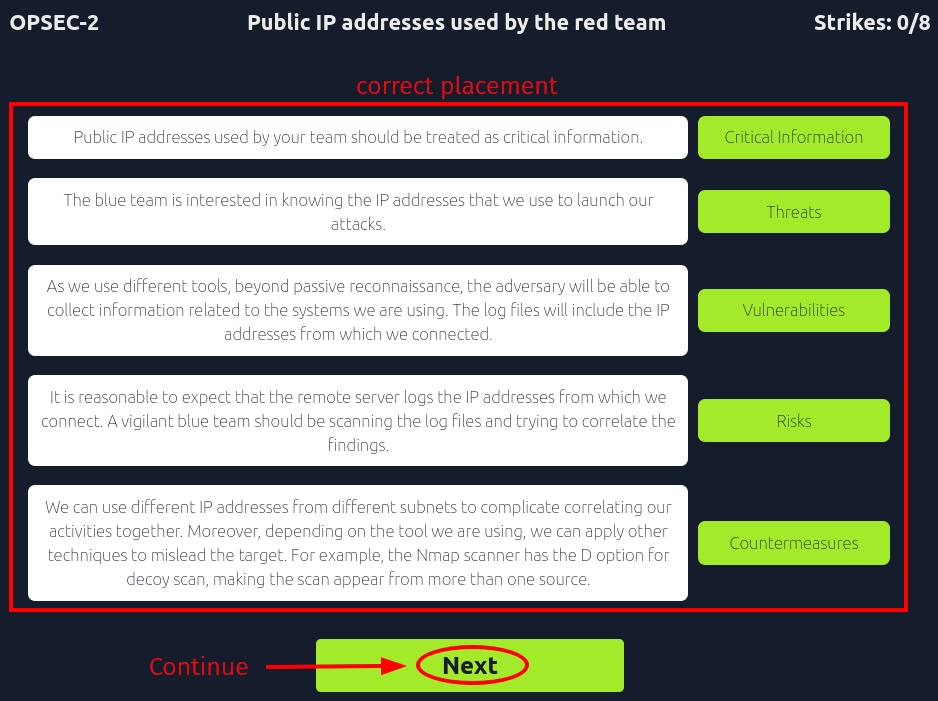
Move around the text blocks to find the appropriate placement.
Lastly, we retrieve the flag.
Summary
Five Elements of the OPSEC Process Quote
- Identify critical information
Critical information includes, but is not limited to, red team’s intentions, capabilities, activities and limitations.
- Analyse threats
Threat analysis refers to identifying potential adversaries and their intentions and capabilities.
- Analyse vulnerabilities
An OPSEC vulnerability exists when an adversary can obtain critical information, analyse the findings, and act in a way that would affect your plans.
- Assess risks
Risk assessment requires learning the possibility of an event taking place along with the expected cost of that event.
- Apply appropriate countermeasures
Countermeasures are designed to prevent an adversary from detecting critical information, provide an alternative interpretation of critical information or indicators (deception), or deny the adversary’s collection system.
Question 1: Memorize the five elements of the OPSEC process and learn how to apply them to the different aspects of your cybersecurity work.
No answer needed